Home for the Holidays? Dogs Would Love That, Too

Read on Substack: https://open.substack.com/pub/thekindlife/p/home-for-the-holidays-dogs-would

Are you looking for a Christmas or holiday present for an animal lover? Since some backyard dogs don’t have appropriate “homes”/shelter, here’s a gift idea that animal lovers and dogs will appreciate. You can contribute, in the gift recipient’s honor, to a sturdy, insulated dog house that will be delivered to a backyard dog, providing warmth in the winter, protection from the elements, and shade in the summer.

Here’s the dog house link: http://bit.ly/4oCK8BN

Here’s a link to additional gifts helpful to backyard dogs: https://presents.peta.org/category/give-by-cause/doghouse/

The reasons why people tether their dogs 24/7 in all seasons vary—inherited family traditions normalizing it, lack of awareness of alternatives, landlord restrictions prohibiting indoor dogs, nonexistent or damaged fencing, and behavioral challenges/destructive indoor behavior. Sometimes, well-meaning people might not realize that these lonely backyard dogs can suffer. You can help via the links above or the ideas below.

Compassion in Action

• Build owner trust – Politely and by using friendly, non-accusatory language, offer help with supplies or walks. The owner is more likely to say yes to offers along the lines of: “I love dogs and have extra time/supplies, could I help with…?”

• Improve shelter and bedding – Add/upgrade a doghouse with walls, raised off the ground (wood pieces under four sides, reducing ground chill transfer), a door flap to block wind and rain, and straw for bedding and joint cushioning (not hay or cloth, which retain moisture and freeze).

• Ensure adequate water and food – Provide a tip-proof water bowl; donate quality food.

• Provide toys – Give the dog chew toys and balls to alleviate boredom.

• Watch for cruelty or neglect and report it – Document neglect (no water or shelter; skinny; an injury) and contact animal control or police department.

https://thekindlife.substack.com/p/home-for-the-holidays-dogs-would

Do Animals Think & Feel?

Read on Substack https://thekindlife.substack.com/p/do-animals-think-and-feel

Ask anyone who lives with pets whether animals think and feel, and they’ll likely raise an eyebrow, privately wonder whether you’re nuts, and answer, of course they do. Over time, more and more researchers have come to agree.

Not long ago—by that I mean the late 20th century—the widely held belief was that animals were incapable of thought and emotion and only reacted mechanistically to stimuli. The foundations of this are traceable in part to 17th century philosopher René Descartes who posited that nonhuman animals were “automata”—complex biological machines devoid of reason, thought, consciousness, sentience, and feeling. Their cries, for example, were machine-like reflexes and pre-programmed responses to stimuli rather than indicative of pain or feeling.

Religion, moral convenience, and psychological and social factors have played a role in this thinking and have justified a comfortable status quo. Christianity, Judaism, and Islam religions believe that humans are uniquely made in the image of God. Only humans possess souls, so goes the thinking, and animals lack inner experience, rational thought, and the ability to feel genuine emotion and pain. There’s a psychological incentive to downgrade or deny animal cognition and sentience and to dismiss animal suffering as robotic reactions—it makes eating meat, animal experimentation, and the cruel practices of factory farming much less troublesome.

For years some scientists and philosophers contended that since animals couldn’t use language to report their inner experience, its existence couldn’t be scientifically validated and therefore should not be assumed. In the early and mid-20th century, strict behaviorists B.F. Skinner and John B. Watson led a movement that focused on observable behavior, treated references to animal consciousness, feelings, and thoughts as scientifically meaningless, and confined research to measurable stimuli and response. For decades the study of animal sentience and concern about the ethical treatment of animals lay more or less dormant.

Over the last several decades, evidence from the disciplines of ethology (animal behavior), animal cognition and comparative psychology, neuroscience and neurobiology, evolutionary biology and psychology, and cognitive science has made it harder to maintain the belief that animals do not think or feel. Researchers began designing experimental methods yielding strong and converging evidence that animals think (demonstrating flexible, goal-directed cognition) and feel (have conscious experiences such as fear, pain, and pleasure). Experiments with diverse mammals and nonmammals (including insects) have shown that various animals can solve problems, plan ahead, remember past events, recognize individuals and self, use tools, display grief, joy, jealousy, empathy, and fairness, and exhibit metacognition (knowing that you don’t know). Brain imaging and neurophysiology have shown a biological continuity between humans and animal brain structures and activity patterns linked to emotion, pain, and consciousness.

A number of scientific groups and conferences have issued statements on animal cognition and sentience. For example, the University of Cambridge Declaration of Consciousness (2012) states that nonhuman animals, including mammals, birds, and sea creatures, have the neurological substrates for consciousness. The New York University Declaration on Animal Consciousness (2024), signed by 500+ scientists, affirms strong support for conscious experience in mammals and birds, and a realistic probability in all vertebrates and in many invertebrates (cephalopods, crustaceans, insects), and urges welfare considerations.

Marc Bekoff, Professor Emeritus of Ecology and Evolutionary Biology, University of Colorado at Boulder, states in his book The Emotional Lives of Animals, “Human beings are a part of the animal kingdom, not apart from it. The separation of ‘us’ and ‘them’ creates a false picture and is responsible for much suffering.”

Intermittently I’ll be writing articles summarizing research findings and providing anecdotal stories about animal cognition and sentience. Stay tuned!

Do you have any personal stories about something an animal did that gave you a window into their thinking? If so, I’d love to hear it.

Compassion in Action:

The next time you are about to buy factory-farmed meat (which is what is sold in virtually every grocery store), consider what that animal likely endured and whether you feel comfortable supporting a large-scale industrial system that prioritizes efficiency and profit over animal welfare. For meat eaters, an alternative is to look for labels that say sustainably raised, locally raised on pasture-based farms, humanely raised, free-range, or Certified Humane, or contact a butcher who will likely know of local farmers who raise animals.

Read on Substack https://thekindlife.substack.com/p/do-animals-think-and-feel

Gracie the Ginger Cat: A Rescue Tale

To View on Substack, please visit: thekindlife.substack.com

Gracie the cat found her way to us when my daughters were young. She had been thrown from a car and made her way to the yard of a kind couple who cared for her. Their inside cat was highly territorial and wouldn’t tolerate another cat, so they sought a home for this ginger-colored cat. Through a friend of a friend, she came to us.

When she entered our house, Gracie was respectful. She moved gently and quietly, her body and pace relaxed. She observed people and animals before doing anything. Our resident cat was unthreatened and curious about her. Our rescue pit bull befriended her, showing his affection by frequently slurping the side of her face. Gracie squinted against it, shook off the spit, and then gazed fondly at the dog.

Gracie connected deeply with my younger daughter in particular and allowed her to do the things that young girls sometimes do: dress the cat in doll’s clothing, push her around in a pram, and drape her over her shoulder and wander through the house.

Gracie seemed to have an understanding of emotional needs of her humans. One example is this: she had always slept with my younger daughter, but the one and only night she changed her routine was when our beloved pitbull died. That night, Gracie divided her time evenly between us, lending her gentle presence by snuggling against us in our beds before moving to the next person.

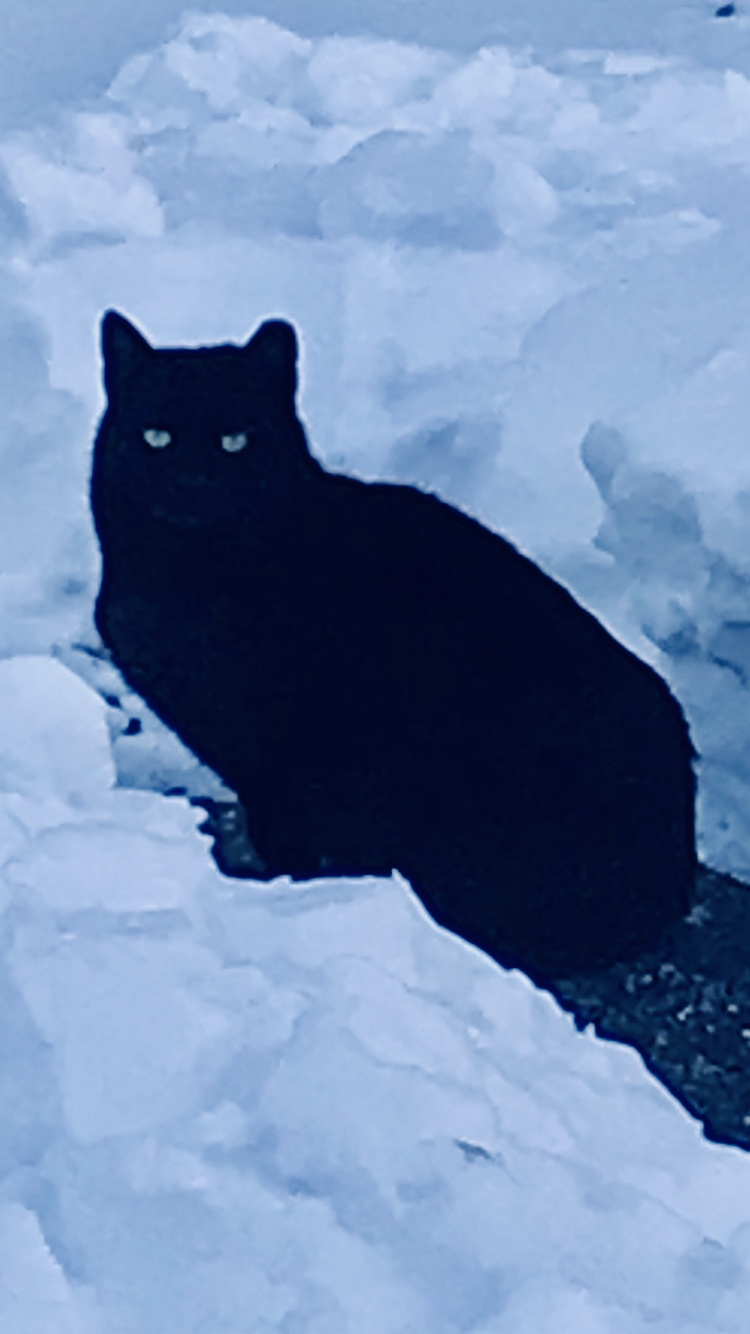
I love this peaceful photograph of her. Gracie sat for a long time gazing out at the twilight snowfall. When she turned, she looked at me, blinked slowly (the cat equivalent of a kiss), jumped down, and sauntered through the house.

Thanks for reading! Subscribe for free to receive new posts and support my work.

Leave a comment

This post is public. Please feel free to share it with anyone who might be interested.

Share

Compassion in Action:

Roughly 6.5 million animals enter shelters in the US each year but only 3.2 million are adopted (ASPCA). Progress has been made: compared to 1973, the number of cats and dogs entering shelters annually is down more than 20 million (Humane World for Animals [formerly Humane Society of the United States]).

If you are in the market for a dog or cat, this site is searchable by location, species, gender, age, color, care and behavior, and whether they’re good with kids, dog, and cats: Find an adoptable cat or dog near you: https://www.petfinder.com/

New Substack: The Kind Life

The Kind Life

Read on Substack

Please take a look on Substack and subscribe for free for a weekly dose of hope with real stories, insights, and simple actions you can take to improve animal welfare.

The Kind Life

I’m Carolyn Cott, an animal-welfare advocate and professional writer who’s always asking, “How can we make things better for the creatures who share our world?” Perhaps you’re asking the same question.

Whether you’re a seasoned rescuer, a caring pet parent, or someone who simply wonders, “What can I do to help?” this space is for you. Here’s what you’ll find:

  • Heartfelt, real-life stories of animals (and humans) that uplift and surprise
  • Research and insights into animal behavior, antics, and communication
  • Myths versus facts about animals, animal advocacy strategies that work, and human-animal connection
  • Interviews with vets, rescue workers, trainers, and public officials
  • Practical ideas—mini-actions and meaningful moves—that you can easily act on

I know that a lot of writing about animal welfare can feel heavy or alarming. Here we shift the tone to hope and curiosity rather than fear, to connection over detachment, and to actions—big and small—that are doable and feel meaningful.

I’d love to hear from you: your thoughts, your questions, even weird things your dog or cat does (my ears will perk up), and topics you’d like to see featured.

Here’s to kindness in action, discovery in every paw print, and shared steps toward a gentler world. Please subscribe for a weekly letter delivered to your inbox and please share this post. Thank you!

Warmly,
Carolyn Cott

This post is public so feel free to share it.

Share

Leave a comment

Worth a look

https://www.facebook.com/share/v/1AJjmiz5kY/?mibextid=wwXIfr

Copper Rules: Life Lessons From a Beloved Soulmate Pet

Copper Rules: What would Copper do? Enjoy the change of seasons!

by Raquel Bruno

I started writing Copper Rules when we lost our beautiful Chocolate Lab Mix, Copper, in June. He was that perfect blend of elder statesman and big brother to all of the fosters we watched over, and then eventually to our children. He was my shadow in every way imaginable from sitting at my feet during morning coffee on the patio to laying by my side as my pregnant belly grew. He had an important role to fill, and he did it unconditionally with great purpose and determination. Dogs are known for their love and loyalty, but Copper was different. His depth of soul was felt by everyone who entered his world, and he made sure that everyone felt welcome in his space.

Since then, I have thought deeply about the lessons he instilled within us and even in the ether, he sends his messages daily through feathers, birds and thought transmissions. Copper Rules came to me as a whisper, almost as if he was telling me a secret in my ear. Today as I write this, Fall has begun to show itself with a dip in temperature as well as a transition from greenery to Copper’s coat color, which are highlighted in the trees as the leaves complete their life cycle—just as Copper did. I am reminded that Copper loved the change of seasons. He loved summer, because he could lounge in the shallow water of the ocean or place his Scooby-Doo like body in a tiny kiddie pool but he loved the change into a cooler temperature because of his heavy coat. We live near woods and when he was still able, he relished the idea of long walks on a forest blanket of yellow, red, and orange crunchy leaves under his paws, and taking in aromatic scents of the earth. It brought him life and vital energy. As with any of our four-legged furry family members, in the summer, walks are reduced due to potential heat exhaustion and being that Copper was more than 100 pounds, we made sure not to overtax him. With Fall, he had the freedom to roam for as long as his body allowed him to. It also served many more benefits for the humans in his life as well: a chance to spend quality time together, explore new areas, take in life as it unfolds, and marvel at the beauty this planet provides—a pastime that all family members can enjoy together.

The other seasons were just as enjoyable to Copper. He would bury his snout deep into a snow bank to catch an animal scent and leap up into snowflakes as they cascaded down on his nose in the Winter. He would chase butterflies and take in the aroma of new grass, gardens and flowers in the Spring. He would sunbathe (even during his last final days) and luxuriate in the pleasure of a shallow wave in the Summer. But I think the greatest thing that Copper would want to convey is to find the beauty in each and every moment—a passing of time, if you will, while having gratitude for what each season brings to us. Some of us love the heat, and some of us, love the cold—but the sentiment stays the same. Enjoying each nuance of the beauty each season provides nourishes us. Spending quality time together in each of those seasons is truly what mattered to Copper.

So, Copper wants to know: How will you enjoy your change of the seasons? Will you try a new baking recipe? Will you invent a new holiday just to spend time with family and friends? Will you go for that walk in a park you have never before explored? Will you truly look for the beauty in each moment the seasons provide?

Copper wants to know!

Raquel Bruno is a TV & Film Producer who runs Drive Entertainment Group & Thrive with Drive. When she isn’t producing or life-coaching, she spends her time raising her two beautiful kids with her husband, writing Copper Rules, DJ’ing, and now training their new addition: a lab/border collie mix her family adopted from North Shore Animal League: the very same place they adopted Copper.

A Voice Like Frank Sinatra’s

A Voice Like Frank Sinatra’s

Why they named me Frank Sinatra, I am not sure.  The neighbors laugh every time they say the name.  From what I understand, Frank was a singer, and they named me because of my voice.  I wouldn’t say it’s mellifluous, like the birds that live at the borders of our pasture, but to my ears the intake breath sound of Hee and outflow breath sound of Haw have a nice, solid sound, like large farm machinery scraping across the floorboards of the barn.  I like that.  It makes me less lonely for my kin.

I do have a friend.  He’s a horse who shares the pasture and barn with me.  His name is Fred.  No last name.  Wherever he goes, I follow.  Mostly he doesn’t mind, but sometimes he swings around toward me with flattened ears, so I back up a few paces.  A little later, when he’s not paying attention, I sidle up and stand near him.  I’m quite a bit shorter than Fred, but I feel that my being near him somehow adds to my stature.

We came here from different places—here being this roomy pasture with a barn, and a man and woman who live in the stone house.  Fred traded hands many times.  He made friends at the first few places, but with each subsequent trade he kept more and more to himself.  He told me, What’s the use in making friends when humans can decide at any time to send you somewhere else?  Horses have no choice.  We’re compliant, and we withstand all sorts of things.  But that doesn’t mean that our hearts are resilient.

Fred came here five years ago.  I don’t think he or I are going anywhere.  That’s the feeling I get from our people, and I’ve overheard them talking about letting us live out our days here.  Still, Fred keeps himself a little apart from me, just in case.  Once in a while, Fred touches my neck with his nose and I bow my head in gratitude.

The man and woman take him on trail rides now and then.  Sometimes I go along, led by a long rope.  I like the change of view and I’m happy not to have all that saddle and gear strapped to me.  We go down to the end of the pasture, out through the gate, across the cool stream, and up into the woods.

Unlike Fred, I wasn’t so much as bought and sold as shunted from one place to another.  Children at one barn rode me a few times before becoming bored with me, so I went to another place where men in straw hats and suspenders and women in long, dark dresses worked me hard. I pulled some contraption across a field, back and forth, back and forth.  I wasn’t fast or strong enough to suit them, and more than once they lashed my back harder than necessary to get their point across.  I strained and tried and sweated, but it was never good enough for them.  They believe that animals were put on earth by god for their use.  Never once did they touch me with kindness.  I closed my mind to it, but I never got used to it.

Eventually they stopped working me and brought in a broader, stouter donkey that pulled whatever they strapped to him.  In the pasture, though, he always stood with his head hanging low, his eyes half-closed.

I was sold at auction to the man and woman I live with now.  They coaxed me into the trailer and then out of the trailer, down the ramp, and into a pasture of tall, sweet grasses.

I kept waiting for things to unravel—for the food to become meager, for a command to pull something far too heavy, but it never happened.  Gradually I came to trust them.

Sometimes at night the man and woman sit on their porch playing wooden stringed instruments.  The woman sings.  Her voice is like a wisp of wind spiraling up into the sky.  Sometimes I’m inspired to sing along with her.  When I do, Fred stands nearby and listens attentively to the sound of our voices in harmony and the kind laughter of the man.

-UntoldAnimalStories.org – We tell animals’ stories, sometimes from their perspectives.  Gentle in our approach rather than shocking, we invite connection, compassion and, from that, action.  We also provide tips on what you can do to help animals, and we seek new action ideas, as well as animal and rescue stories, from you….  Please contact us at untoldanimalstories@gmail.com or via our contact page.

Michael & Cheeky the Squirrel

Cheeky the squirrel jumped into the truck then, realizing what she’d done, dashed out.  She stopped a stood a few feet away, curling her forepaws to her chest and gathering herself.  Michael shook his head.  He rummaged around in his glove box, found a bag of old, unshelled peanuts, and held one out to her.  Cheeky stood on his foot and took the peanut gently from his hand.

He hadn’t seen her in a year since he’d moved to a different part of town.

Michael had first seen her on the roof outside the kitchen window, peering in at him.  He slid up the screen a fraction of an inch and pushed a walnut through the crack.  She snatched it and ran off, jumping from the rooftop and the locust tree in one graceful arc.

The next day she came again, and the next.  Each morning she waited, squinting in through the glass’s reflection, for him to notice and feed her.  On snowy days, she hopped from one foot to another to keep from freezing.

By spring she abandoned the rooftop and waited instead on the rail by the front door, somehow knowing each day when he left.

On summer mornings Michael sat in the garden drinking his coffee.  He held the newspaper with one hand and dangled unshelled peanuts for Cheeky with the other.  She slipped them from his fingers with exquisite gentleness.

When he was getting ready to move across town, he worried about her.  Would she have enough food?  On walks in the neighborhood Michael counted the nut-producing trees and judged the distance to the trickling stream.

On the morning he packed the last of the boxes into his truck, he waited for Cheeky to arrive, but she never came.  Maybe she was watching him from somewhere.

Michael  thought about her from time to time.  The day he returned to the neighborhood to visit a friend, he closed the door of his truck, leaned against it, and looked around.  He saw her coming toward him, stopping and looking, then advancing.  He swears they were both smiling at each other.

•photo by Cherie Damron

Sheba’s Transformation: From Fear to Friendship

by Robert Leardi, MD

I have loved dogs all of my life, but because my parents wouldn’t allow one in the house, I had to wait until I was out of the house and married before getting one. Since then, many dogs have been in my life, and all but one have been shelter dogs.

The one non-shelter dog was a retired show dog—a Cavalier King Charles Spaniel. She was a beautiful 10-year-old, extremely affectionate dog who, like all the dogs in my life, quickly bonded with me. After three months, she suddenly collapsed and died.

Afterward, my daughters began sending me photos of dogs from local shelters. One that caught my eye was a mixed-breed rescue named Sheba, thought to be under six years of age. She reminded me of my first dog, Prince, a Springer Spaniel mix who bonded with me instantly and seemed always to know want I wanted him to do without being asked. He also knew when I was coming home, although my arrival times varied. When we walked, he was at my side, never needing a leash.

Sheba’s adoption records showed that she had been seized by authorities in West Virginia “from a bad situation.” Like so many rescue dogs from the South, she was transported to the North for adoption. I adopted her in June 2023 through a local rescue, Hinde Animal Rescue in Media, PA.

Sheba

Sheba bonded with me quickly, but her mistreatment caused her to be terrorized by almost everything and everyone else. When I stopped to talk with neighbors on our daily walks she would whimper and pull away. Traffic frightened her, as did anything sudden or different. With me, Sheba was calm. I felt honored to be trusted by her and sought ways to expand her sense of safe. A dog psychologist evaluated her but was unable to help her beyond prescribing Fluoxetine, which had to be halved due to side effects.

The elements of time and loving patience seem to have helped the most. It’s been two years since I adopted Sheba, and she now sits or lies down patiently when I talk to neighbors, and her fear of traffic has passed. She is a low-energy, calm dog who loves to walk slowly, doesn’t pull, and walks with a slack leash. She refuses to play fetch, and when I throw a ball for her, it is I who has to retrieve it. Sheba smiles when she looks at me and has become the love of my life. She has become the companion that she is because she lives in a consistently loving environment. I suspect I have derived as much comfort from living with her as she has from living with me.

A tribute to all the dogs that have been in my life.

Gracie’s Journey: From Abandonment to Family

Gracie the cat found our way to us when my daughters were young. She had been thrown from a moving car and landed, limping, in the front yard of a kind couple who cared for her. They couldn’t take her in because they’re inside cat was quite territorial and wouldn’t allow it. And so they sought a home for the ginger-colored cat, and through a friend of a friend, she came to us. 

When she entered our house, Gracie was respectful. She moved gently and silently, her body and pace relaxed. She observed people and animals before doing anything. Our resident cat was unthreatened and curious about her. Our rescue pit bull befriended her immediately, and he frequently showed his affection by slurping her face. Gracie tolerated it, squinted against it, shook off the spit, and then gazed fondly at the dog.

Gracie connected deeply with my younger daughter and allowed all the things that young girls do with cats: dressing her up in doll’s clothing, pushing her around in a pram, draping her over her shoulder and wandering through the house.

Gracie had an understanding of things. One example is this—she always slept with my younger daughter, but the one and only night she changed her routine was when our beloved pit died. That night, Gracie divided her time between all of us, lending her gentle presence and snuggling against us in our beds before moving to the next person.

I love this picture of her. The backdrop is a twilight snowfall. Gracie sat for a long time, gazing outward at the evening. When she turned around, she looked me in the eye, blinked slowly, jumped down, and sauntered through the house.